
The Fan Book
A family history you can read like a book and find your way through like a map.

Your whole family in one picture
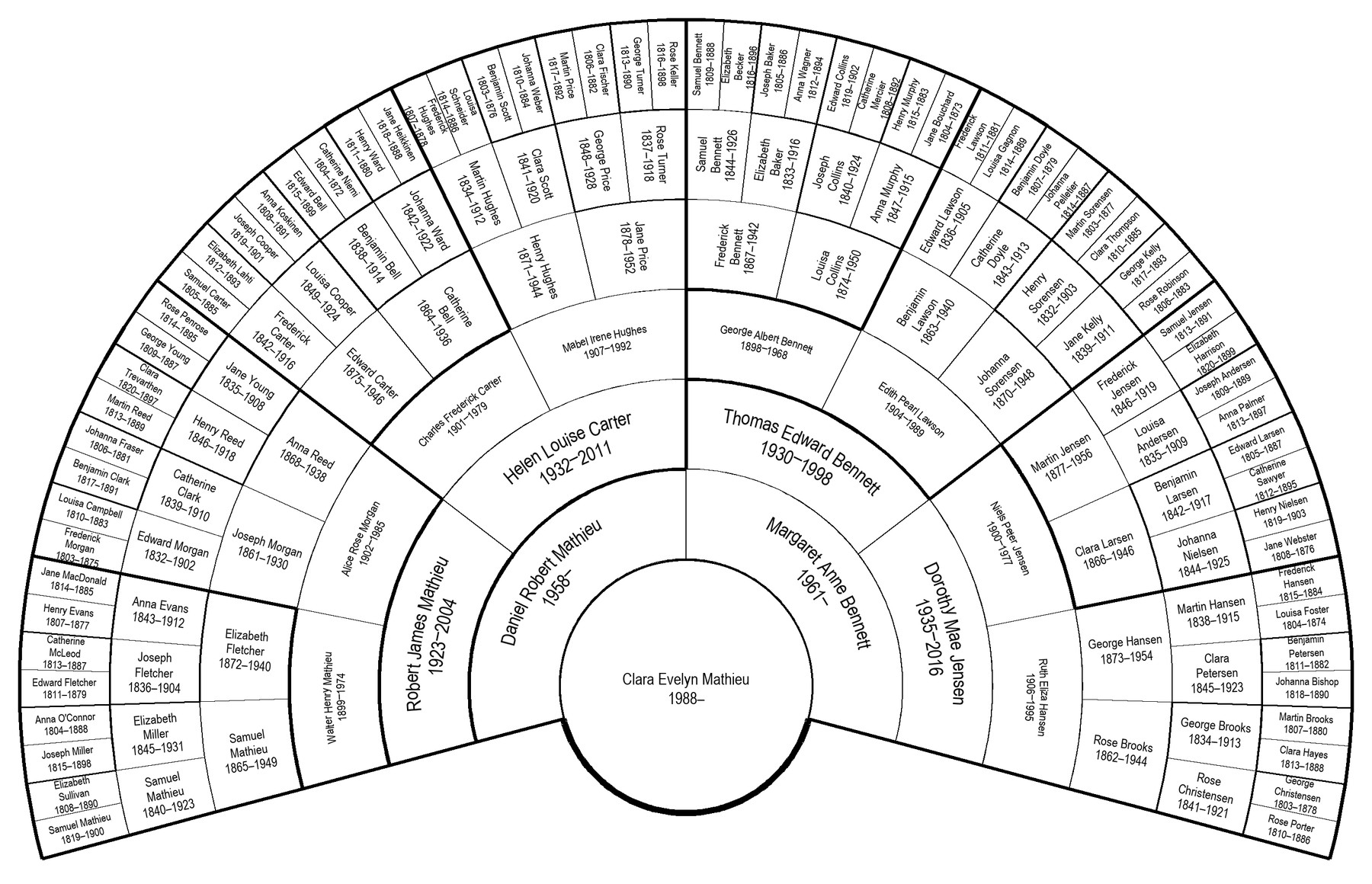
A fan chart starts with one person at the center. Their parents form the next ring, then grandparents, then great-grandparents, each generation fanning out a little wider than the last. Seven generations back, the fan holds 127 people. You can see every one of them at a glance. Discover which lines reach far back, where the gaps are, and how many different paths led to one person.
That's why so many families hang a fan chart on the wall. It shows the shape of a family in a way no list can.
The same chart, seen another way
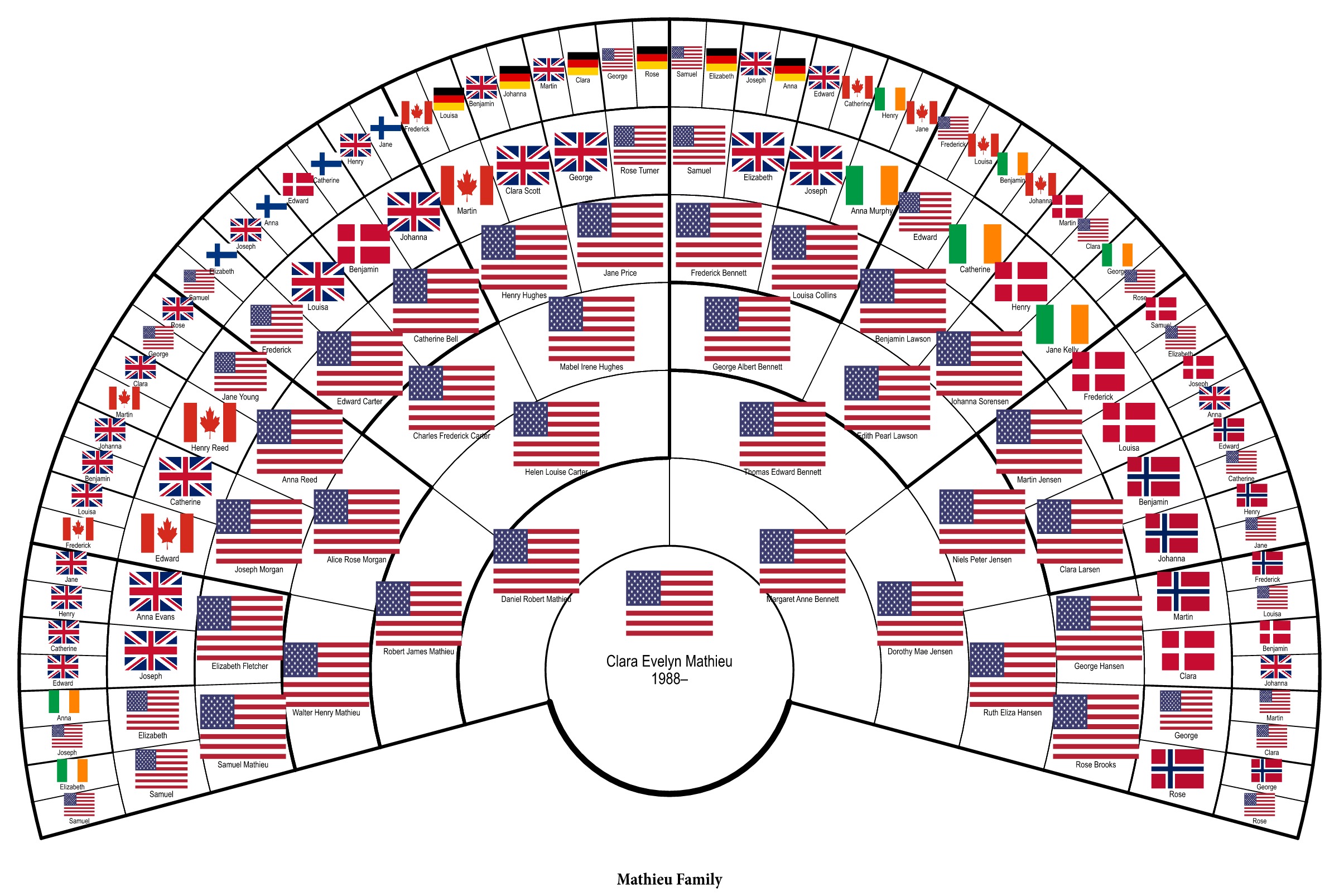
A fan chart can show more than names. A flag fan chart puts the flag of each ancestor's birth country in their wedge, so you can see where your family came from at a glance. A photo fan chart puts each ancestor's portrait there instead. FanChartBook Deluxe builds both. See the Flag Fan Chart Builder
A chart tells you who. A book tells you their story.
A chart on the wall leaves you with questions. Who were these people? Where did they live? Why did they leave their homelands, and how did their families find each other?
Answering those questions takes a book, and turning a fan chart into a book that reads well is harder than it looks. Organize it by generation, and husbands and wives end up chapters apart from their own parents. Follow one line at a time, and the same people appear again and again. List everyone alphabetically, and you have a reference book nobody reads cover to cover.
The fan book method solves that.
How a fan book is organized
Four ideas shape every fan book:
- The chart is divided into eight sections.
Each section is one branch of the family. It consists of a slice of the fan, with all of its people together. Every fan book has eight sections, however far back your tree reaches. - Couples stay together.
A husband and wife are always presented side by side, so their story is told once, as a family. - Each section moves forward in time.
Every section begins with its oldest generation and follows the family forward until that branch joins the next. By the last section, the story has arrived at the person at the center of the chart. - Every person has a code.
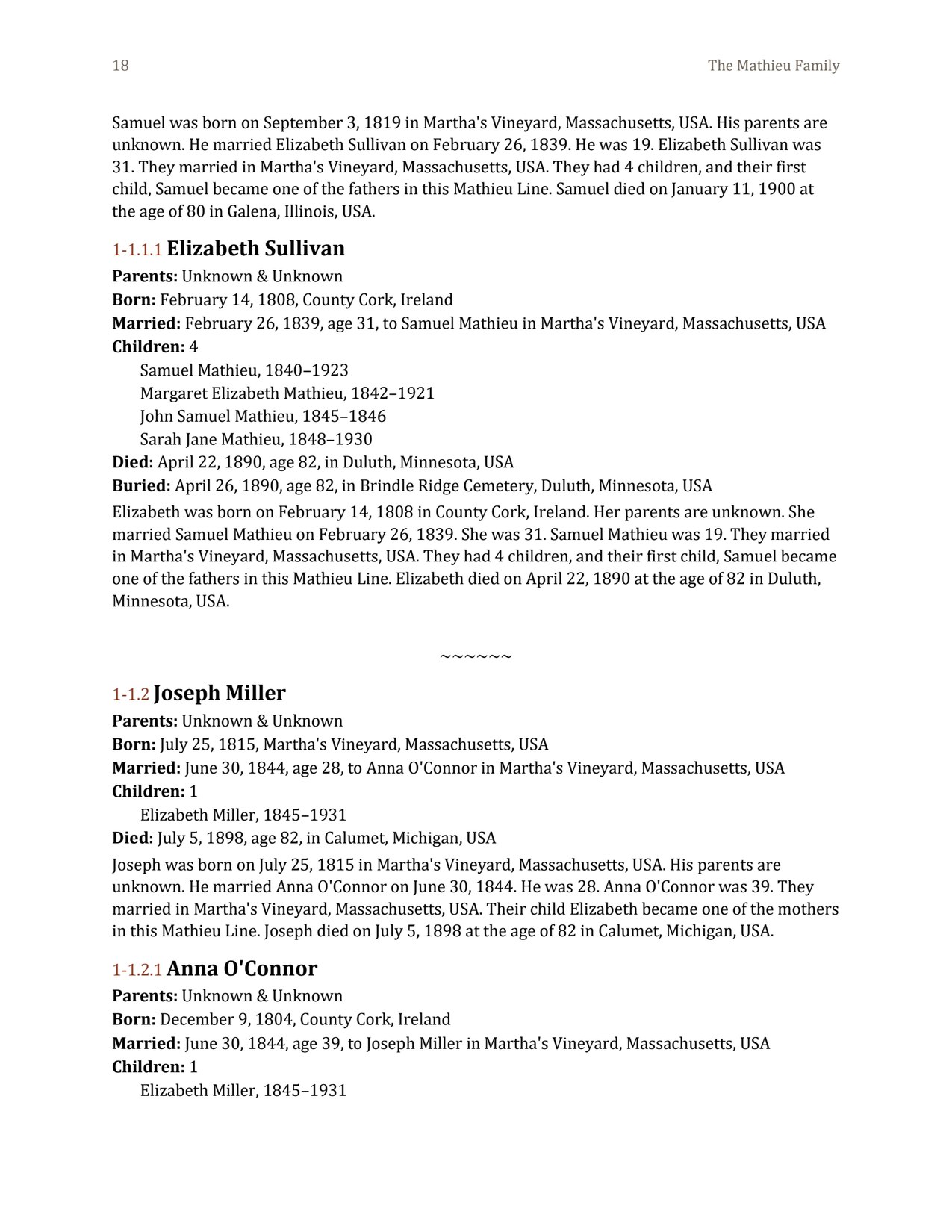
Each ancestor carries a short code, such as 1-1.1, that matches their place on the fan chart. Find a code in the book and you can find the person on the chart. Find someone on the chart and their code leads you to their page.
You always know where you are
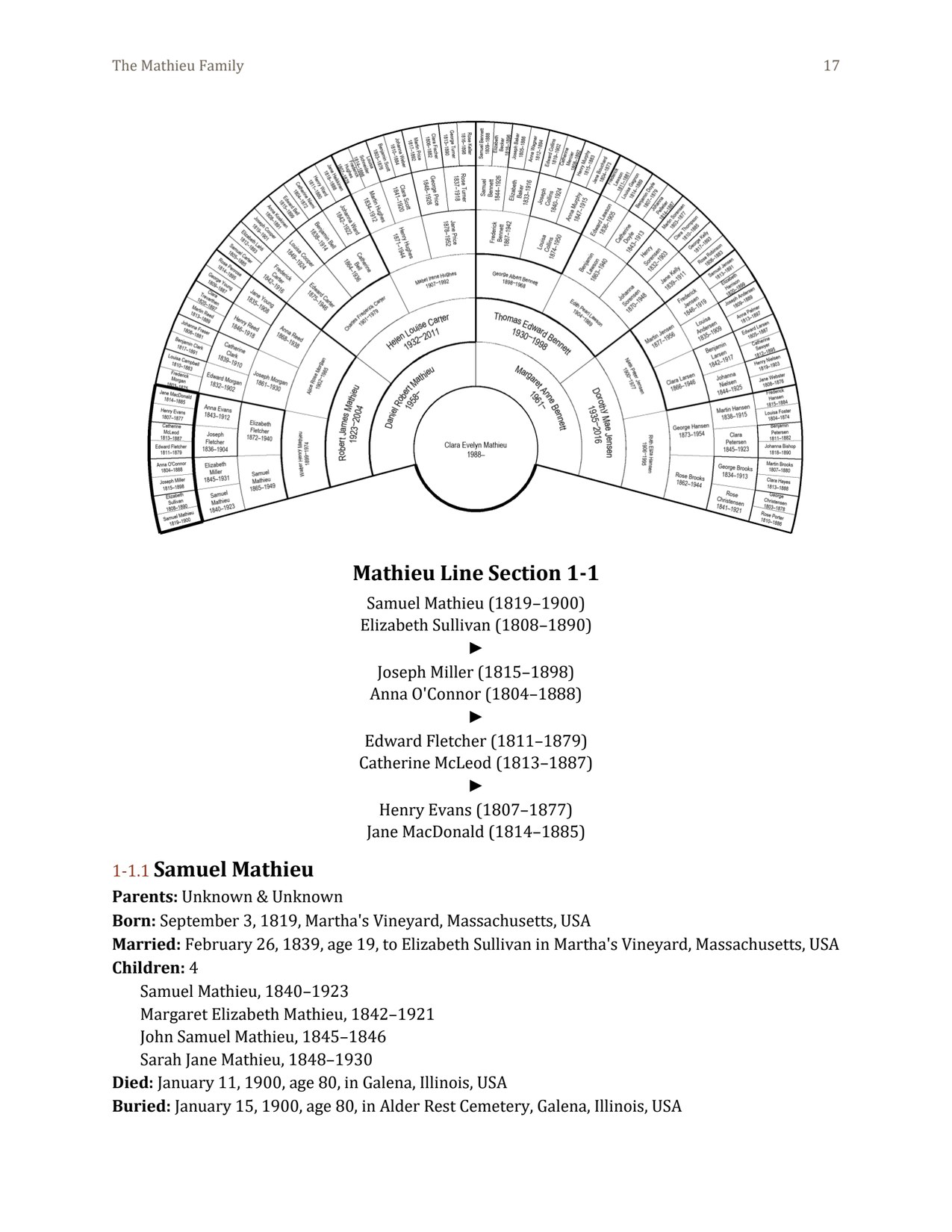
Each section opens with the fan chart with its branch highlighted. Before you read a single name, you can see which part of the family you're about to meet and how it connects to everyone else.
Then the section brings that branch to life:
- where each person was born, and how far apart those birthplaces were
- maps of where your ancestors were born, when your family file has place locations (FanChartBook can look them up for you)
- a life sketch for each ancestor, ready for the stories and photos you add
Big enough to matter, small enough to finish
Every generation you add roughly doubles the number of people on the chart. A fan book reaches back up to seven generations, counting the person at the center as the first. Seven generations holds 127 people. This is enough to reach back two centuries or more in most families, and still a book you can research, write and finish.
Your tree doesn't need to be complete. Where someone isn't in your tree yet, their place in the book stays open, with a reminder for your research.
It doesn't have to stop there. Any person in your family tree can be the center of their own book. Choose a grandparent, or an ancestor on the outer edge of your fan, and FanChartBook builds a new book with that person at the center, reaching up to seven generations further back. From each new fan, you can do it again. The only limit is how far your family tree goes.
That's how the method began: one book for each of Doug's four grandparents, then one for each of his wife's parents.
Worked out by hand, one book at a time
The fan book method grew out of years of family history work, starting with a translation of a 1735 German family history and continuing through other family books. Each one showed something about what makes a family history readable.
The method took its final shape across six fan chart books, each built by hand and each taking five or six months to research, organize and write. The first took longest because the approach was still being discovered. The process began with organizing by generation, then by individual family lines. It eventually settled on sections that keep couples together and give every person a code.
FanChartBook does the organizing that took those months, in minutes. The time that's left goes to the part only you can do: the stories, the photos, the keepsakes and the memories.
Made for an evening by the fire
A fan book isn't a directory you look things up in. It's a book you sit down with, a branch at a time, meeting the people who came before you in the order their lives unfolded. And whenever you wonder how someone fits, the chart is right there to show you.