
About Doug Nufer
My interest in family history began with a red book I couldn't read.

THE RED BOOK
When I was young, my father's Uncle Lloyd sent our family a reproduction of a German family history originally published in 1735. It traced the Nufer line back into the 1400s. Outside my own family, I had never met anyone with my last name, so discovering that someone had preserved centuries of our history was fascinating. Unfortunately, the book was written in German and Latin. Much of it was in an old Gothic typeface. I could barely identify the letters, let alone understand the stories.
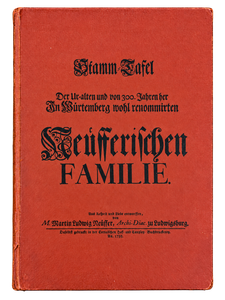 Years later, my first job out of college, at WordPerfect, gave me the tools to begin unlocking that book. I painstakingly typed it into a computer, deciphering it letter by letter and using German-English and Latin-English dictionaries to work through the text. It became an occasional project that stretched over years, but eventually I could read about the people whose lives had been hidden in those pages. I bound copies of my translation for my family, then began gathering more recent histories to connect those distant generations to the people I knew.
Along the way, I inherited some of Uncle Lloyd's family history materials. I was grateful for what he had preserved, but I regretted not having asked him more questions while he was alive. His papers could tell me only so much. Other stories and explanations had gone with him. This heightened my desire for current generations to preserve memories for future generations.
FROM WALL CHART TO BOOK
Eventually, I hung large fan charts of my family and my wife's family on the wall. I enjoyed studying them, but they brought an uncomfortable realization. Thanks to the Red Book and my subsequent research, I knew quite a bit about one ancestral line. Most of the other people on those charts were strangers. I could read their names, but who were they? Where had they lived? Why had they left their homelands, and how had their families eventually come together?
I decided to branch out across the fan chart, exploring the countries each line came from and when those families arrived in America. I chose my four grandparents as the starting people for four separate books, each identified by that grandparent's surname and covering all the ancestral lines on their chart. I also discovered how quickly the project could grow. Adding a generation roughly doubled the total number of positions on the chart, so I limited each book to seven generations, counting the grandparent as the first.
Turning those charts into readable books proved surprisingly challenging. I tried organizing people by generation and following individual ancestral lines, but those approaches separated families, interrupted stories, or repeated information. Through trial and error, I developed a way to divide the chart into sections, keep couples together, and follow families from earlier generations toward the present. A coding system connected each person's place on the chart to their story in the book. Highlighting a key portion of the fan chart at the start of each section created a kind of map, so readers could always see where in the family each group of people belonged. That became the foundation of my fan chart methodology.
Each of the four books took about five to six months to research, organize, and write. The first took the longest because I was still discovering the approach. Online family tree sites became an invaluable resource, alongside family archives and other genealogy sources. As I gathered photographs, records, and stories, the names on the charts gradually became people I felt I knew.
I also enjoyed discovering what the collected data could reveal about the family as a whole. Which months were the most and least popular for weddings? What percentage of the ancestors came from each country? When did they immigrate, and which ships carried them? Who had served in the military during various wars? These details offered additional ways to explore our history and notice connections that individual biographies might not reveal.
After finishing the books for my side of the family, I wanted my children to know their mother's heritage as well. I produced books for both of her parents' lines.
WHY FANCHARTBOOK
Then I thought about my sons- and daughters-in-law. Their histories mattered to our growing family too, but I couldn't devote another five or six months to every book. I began contemplating an application that could handle the initial work of assembling and organizing the information.
Those thoughts eventually led to FanChartBook. Using a GEDCOM file exported from genealogy software, it can organize the data into a fan chart, assign placement codes, put people into the proper order, and generate a core family history book in minutes. That foundational work used to take me months for each book. FanChartBook does it for you and leaves you with an editable core book to review and build upon.
From there, a person can add photographs, charts, family stories, expanded biographies, and whatever else they want to preserve. As I developed FanChartBook, I kept adding tools to help with that work, drawing on the tasks I had encountered while manually creating my own books. Watching the organized information grow into a personal family history is tremendously rewarding.
What keeps me interested is the opportunity to understand these people and the lives they lived. Their experiences give me perspective on my own life and encouragement to be a better husband, father, son, brother, uncle, citizen, and neighbor. My hope is to help others create books their families will want to open, explore, and pass along, giving future generations a chance to know the people who came before them.